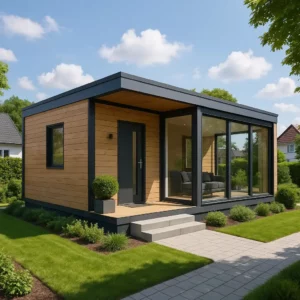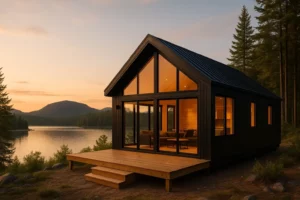
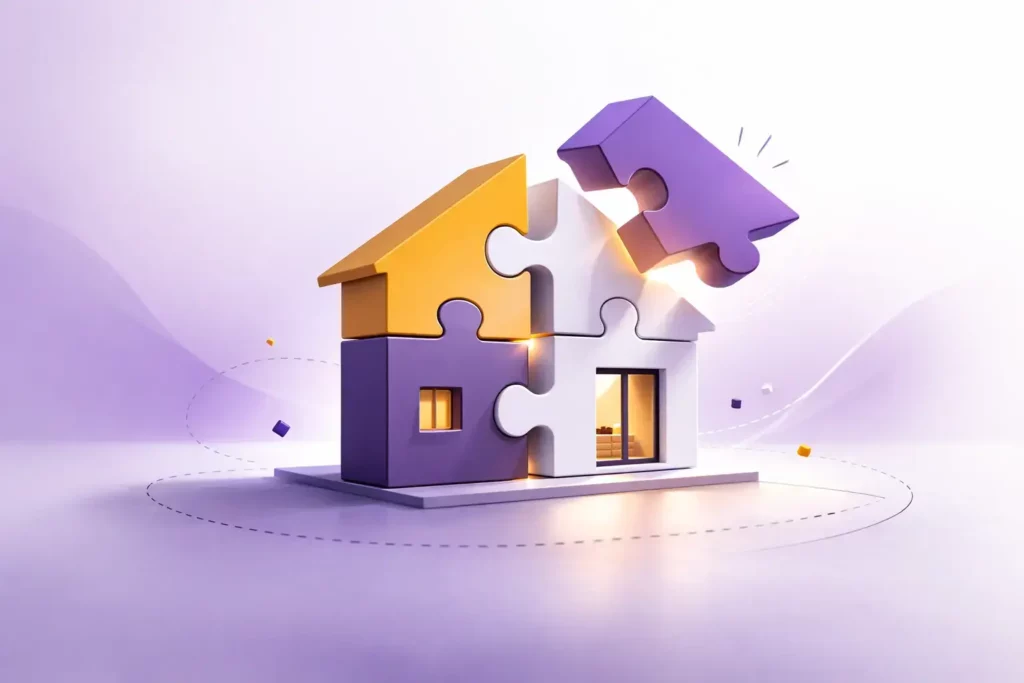
There prefabrication It consists of manufacturing part of a house in a factory, then assembling the elements on site.
Instead of building everything outside, the components are manufactured in a controlled environment.
The result: faster, better planned and often more predictable construction.
Today, prefabrication is at the heart of many residential projects in Quebec, for family homes as well as cottages and tiny houses.
What exactly is prefabrication?
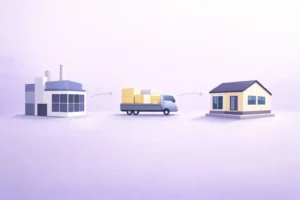
Prefabrication involves manufacturing part of a building before it arrives on site. These elements are generally produced in a factory, then transported and assembled on site.
In practice, this means that components such as walls, floors, certain roof sections or even complete modules can be prepared in advance.
On site, the work focuses mainly on foundations, assembly, technical connections and finishing touches.
For a complete definition:
https://collectionimmobiliere.com/quest-ce-quune-maison-prefabriquee/
Why is prefabrication so effective?
More stable quality
In the factory, the work is repetitive and controlled. The materials are protected and the steps are checked.
👉 Fewer surprises
👉 Better accuracy
👉 More reliable assembly
Simple example
A wall built in a dry environment reduces the risk of moisture and damaged insulation.
Shorter lead times
A major strength of prefabrication is the ability to work in parallel.
While the factory is building the house, the land can advance (e.g., foundations).
CMHC points out that this approach allows for significant time savings in certain modular projects.
Less waste
In the factory, the recovery of material scraps is more organized. This allows for better management of surpluses.
- Reducing waste
- A more environmentally friendly process
More predictable costs
A planned and standardized construction reduces errors and rework.
- More stable budget
- Fewer unexpected events
To explore the costs:
https://collectionimmobiliere.com/maison-prefabriquee-prix-guide-2026/
Less weather impact
A significant portion of the structure is manufactured indoors.
- Fewer risks related to rain and humidity
- Shorter construction site
Transition: a house can be prefabricated at different levels
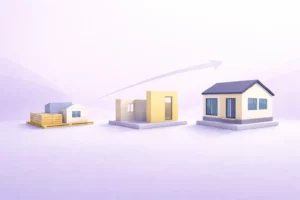
Not all prefabricated houses are the same. Some arrive in pre-cut pieces. Others arrive with complete walls. Some arrive in almost finished modules.
We are therefore mainly talking about 3 formats:
- kit house
- panel house
- modular house
For a broader overview:
https://collectionimmobiliere.com/types-de-maisons-prefabriquees-apercu-et-styles/
Quick comparison of the 3 types
| Kind | Level of prefabrication | What happens | Terrain speed | Advantage | Limit |
|---|---|---|---|---|---|
| Kit | Low to medium | Pre-cut materials | Variable | Self-build and flexibility | More coordination |
| Panels | AVERAGE | Wall sections | Rapid structure | Good compromise | Precise logistics |
| Modular | Pupil | Complete modules | Very fast | Short lead times | Transport and access |
Kit house
A kit home represents the most flexible level of prefabrication. The materials are prepared and organized, but the assembly takes place primarily on-site. The image of LEGO bricks illustrates this principle well.
Benefits
-
More flexible
-
Promotes self-build
-
Can reduce certain costs
Boundaries
-
Longer construction project
-
Greater coordination
-
Quality depends more on the installation
Panel house
The panel house offers an intermediate level. The walls and some structural sections arrive already assembled, which speeds up the installation of the structure.
Benefits
-
Good balance between speed and price
-
Fewer measurement errors
-
Improved waste management
Boundaries
-
Logistics for delivery
-
Some finishing touches remain on site
Modular house
Modular homes represent the highest level of prefabrication. Complete sections, called modules, are manufactured in a factory and assembled on site. These modules can already incorporate several systems and finishes.
Benefits
-
Very quick installation
-
Consistent quality
-
parallel work
Boundaries
-
Complex transport
-
Dimensional constraints
-
Important access to the grounds
Common Myths
Several myths persist about prefabricated construction. Some believe that a prefabricated house is less sturdy or comparable to a mobile home. In reality, these structures are designed to be permanent and meet the same standards as traditional construction.
Customization is also possible, although certain logistical constraints may influence the design. Finally, prefabrication is not always cheaper, but it generally offers better cost predictability.
Conclusion
Prefabrication is based on a simple principle: moving part of the construction site to the factory in order to better control quality, deadlines and planning.
Choosing between kit, panels and modular depends mainly on the budget, the land, the desired deadlines and the level of involvement in the project.
To explore the available models:
https://collectionimmobiliere.com/page-filtre-modeles/
Estimate your budget:
https://collectionimmobiliere.com/simulateur-de-cout-pour-maison-prefabriquee/
For free support:
https://collectionimmobiliere.com/accompagnement-pour-projet-de-maison-prefabriquee/
Sources
Modular Building Institute
https://fr.modular.org/what-is-modular-construction/
https://fr.modular.org/2021/07/14/modular-vs-prefab-whats-the-difference-2/